
On Projecting Climbs
Projecting is not just trying hard. It is reading the climb, reducing hesitation, and turning each session into a learning loop. Here are the small adjustments that helped me dial beta faster, waste less energy, and tell the difference between a grade plateau and one climb that is not fully dialed yet.
Juan A. Lopez Cavallotti
Progression AI Founder
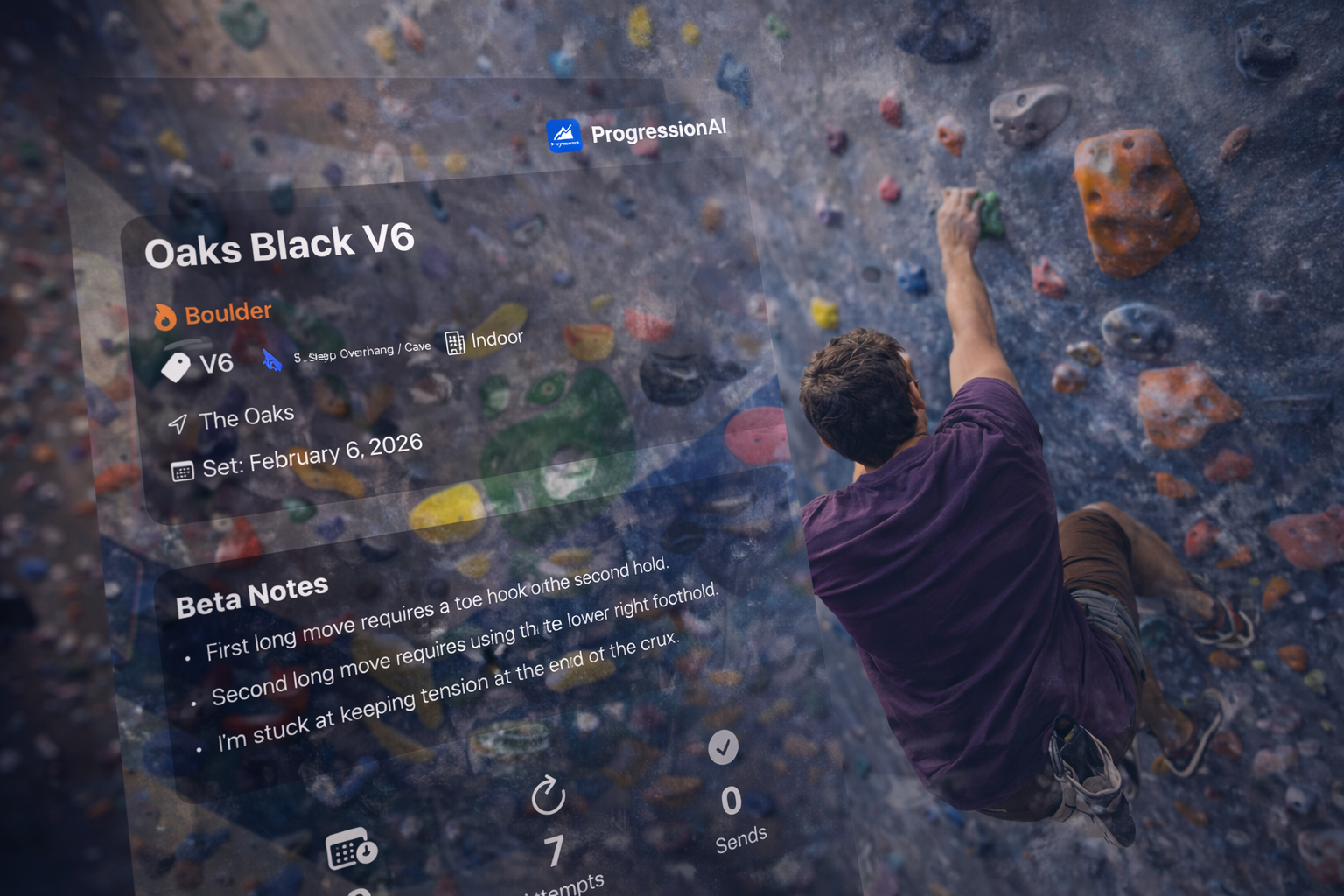
When I first tried projecting, I thought the right way was to start from the bottom every time. No shortcuts. No planning. Just go for it.
That didn't work.
I'd waste energy on the easy part, then hit the hard moves already tired and frustrated. I kept failing in the same spot because I never stopped to think about what I was actually doing wrong.
Looking back, I wasn't able to do many climbs I was strong enough for. It wasn't a strength problem—it was a method problem.
The beginner trap: trying without reading
A project is not just a hard sequence. It is a problem you solve over time.
If you never stop to read the climb, you end up doing the same thing every time:
- You repeat the same “comfortable” moves.
- You fall in the same spot.
- You learn slowly because you are always improvising.
I was also missing a big piece: mentally running the climb before I pulled on.
I was not really looking at where the holds were.
I was not imagining body positions.
I was not thinking about what I would do if a foot slipped, or if I arrived at a hold in a slightly different orientation.
So mid-attempt, I'd end up searching—and searching costs time, power, and precision exactly when you need them most.
The adjustments that changed everything
After watching and reading a lot of content about projecting, I made a few changes. None of them were dramatic. Together, they completely changed how fast I learned.
Record video of my attempts
I started recording short clips of my attempts—not because they look cool, but because they reveal the truth:
- Where my hips drifted away from the wall.
- Which foot cut first.
- Whether I hesitated.
- Whether I fell because of strength, or because of positioning.
It is hard to remember an attempt accurately when you are pumped and emotional. Looking from the outside allows me to see where gravity is taking me and which parts of my body are actually working—video turns "I think I slipped" into "I dropped my left foot when I re-gripped."
Stop doing every attempt from the ground
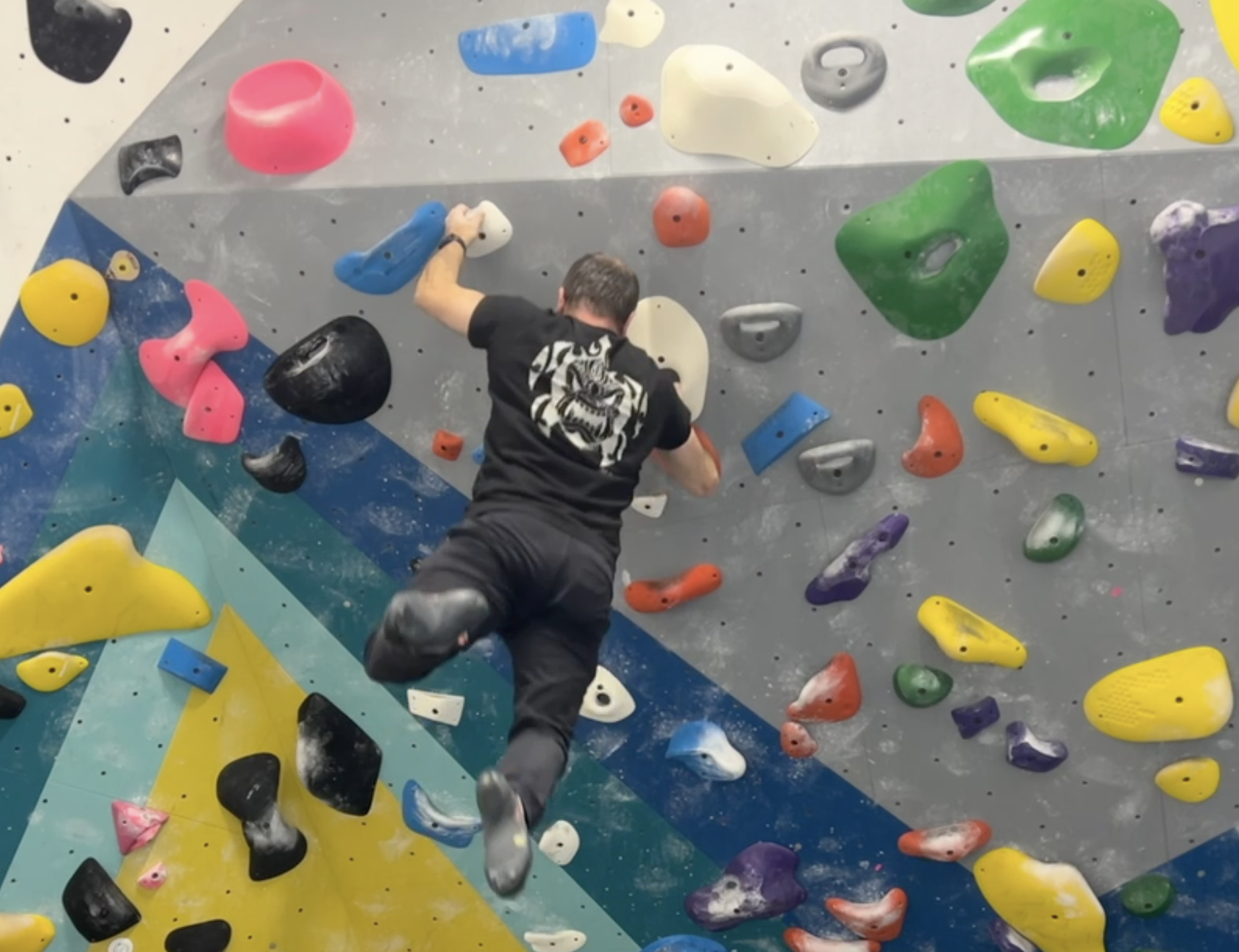
Instead of trying full attempts from the bottom, I'd climb to where I was stuck and work from there.
I would:
- Practice different sections.
- Try different sequences.
- Experiment with body positions.
- Try a different foot.
- Try a different hand.
Working the specific section where I was failing meant I spent energy learning, not repeating.
Mentally, this turned what seemed like an impossible climb into a simpler problem: sometimes I just couldn't do one move. That shift helped a lot with motivation.
Write down beta and rehearse it like choreography
Once I found something that worked, I wrote it down.
Then I rehearsed the sequence mentally as if it was choreography:
- Which hand goes where.
- Which foot flags.
- Where I breathe.
- What I look at.
It sounds obsessive, but it saves enormous mental energy during an attempt. When things get hard, your goal is to execute, not invent. Those few seconds of conserved power can make the difference between sending and falling.
And when you do things right, your body learns. Next time, you do it more instinctively.
Refine micro-beta (it matters more than anyone thinks)
After I had a “good enough” sequence, I started refining micro-beta.
Micro-beta is everything that looks too small to matter until it is the reason you send:
- Exactly where on the hold you grab.
- How you angle your thumb.
- Which edge of the foothold you trust.
- Whether you turn your hip in or out.
- Whether you hit the hold static or with a tiny bump.
Two sequences can look identical from the ground and feel completely different in your body.
The bigger lesson: eliminate searching under load
This is worth repeating because it’s easy to miss:
a huge part of “strength” on a project is avoiding unnecessary effort.
If you do not fully read the climb and remember where the holds are, you end up searching mid-attempt.
And searching costs time, power, and precision in the worst possible moments.
How this became a product feature
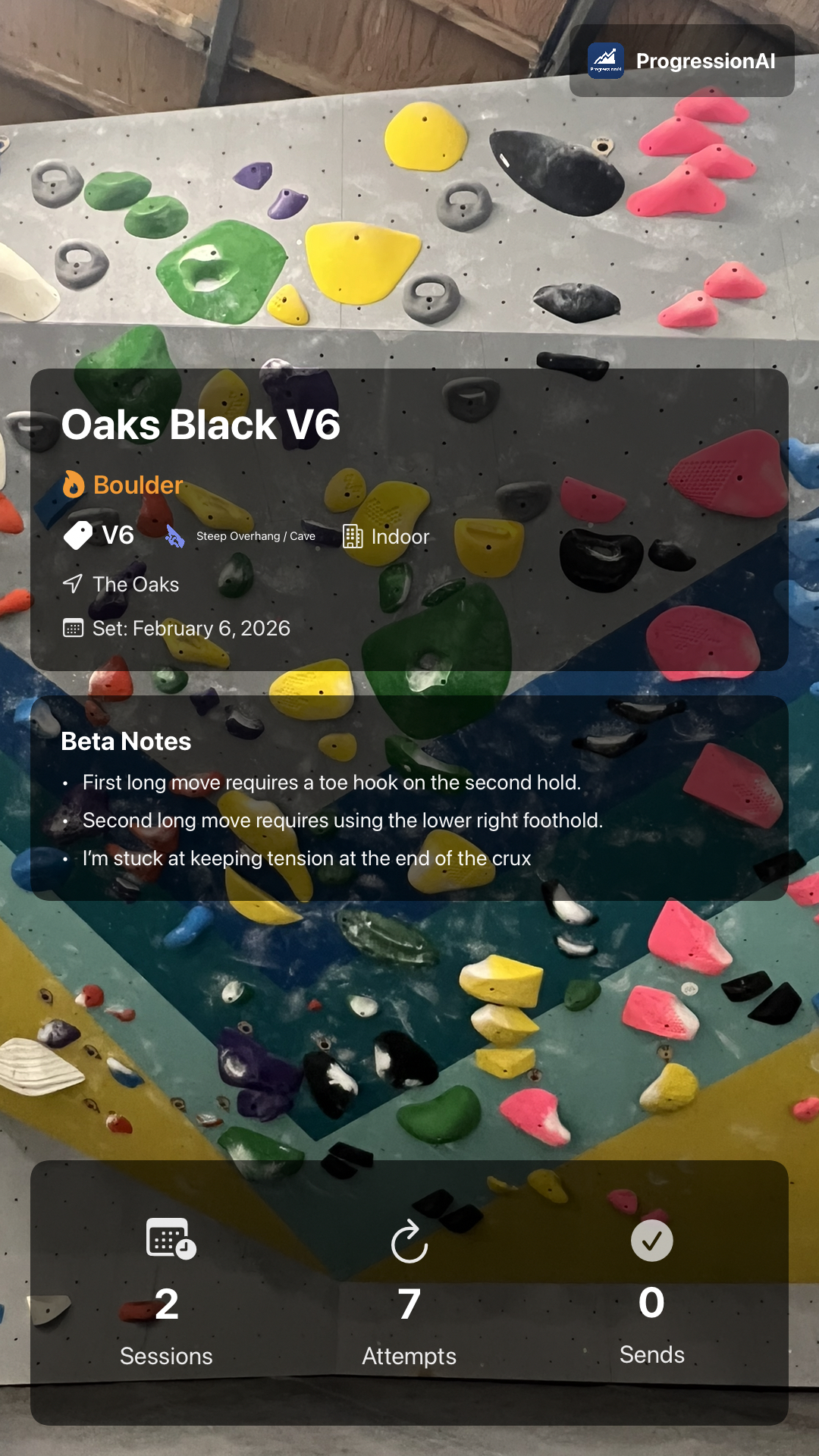
This whole process ended up spilling into something else: I built the Climbs feature inside Progression AI.
I wanted a single place where I could:
- Store my attempt videos.
- Track my projects.
- See how many sessions and attempts it took to complete a climb.
- Save important beta details between sessions so I did not start from scratch every time.
In other words: I wanted to treat projecting like what it really is.
A learning loop.
It also helps me see the difference between being genuinely stuck at a grade and just having one climb that isn’t fully dialed yet.
If you are new to projecting and it feels daunting, that is normal. But it gets a lot less intimidating once each session has a purpose, and each attempt teaches you something specific.
If you want a simple way to stay consistent, download Progression AI and start tracking your projects today. The goal is not to log everything perfectly. It is to make each session a little more intentional.
Keywords
Juan A. Lopez Cavallotti
Progression AI Founder
I am a rock climber and a software engineer. I am very passionate about training and love all kinds of sports and the outdoors.
Follow on Instagram (@juan.climbs)