
Finger & Wrist Injury Prevention: A Climber’s Nutrition + Recovery Guide
Fingers and wrists take a beating in climbing, and most issues build up slowly from overuse. This post is a practical guide to help you keep tendons, pulleys, and joints healthy with a few high-leverage basics: enough protein, vitamin C, key minerals, adequate daily energy, and smarter recovery and load progression. Use the mini guide to make simple changes you can apply this week to reduce injury risk and keep your sessions high quality.

Abril Guita
Nutritionist
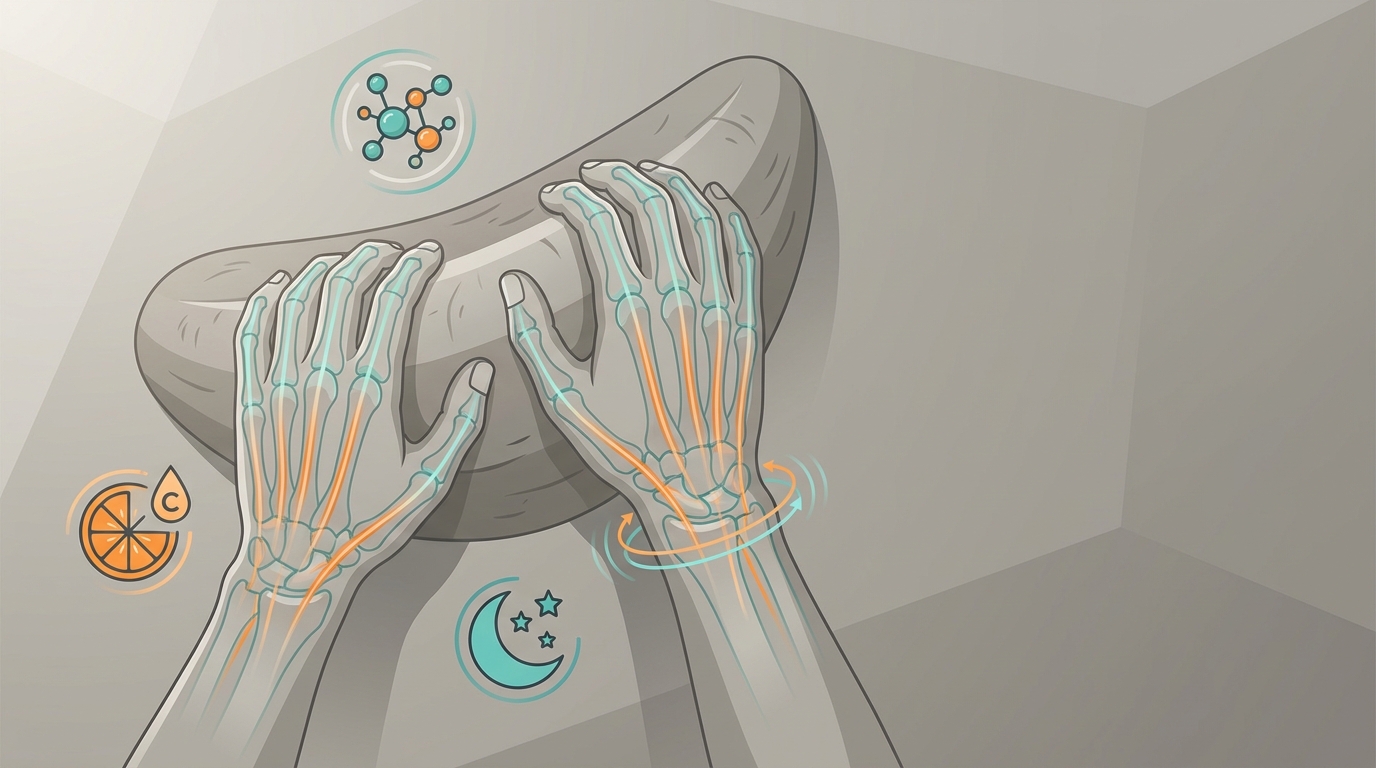
Most common injuries in climbers
In climbing, the structures most often injured are not the large muscles but the small, specialized tissues in the hands. Tendons, finger pulleys, ligaments, and joint capsules bear very high loads on small contact areas, which explains why most discomfort and injuries concentrate in the fingers and wrists. These injuries usually appear progressively, more from overuse than from a single traumatic event.
Tendons have less blood supply than muscle, which means they receive less oxygen and fewer nutrients for repair. While muscle adapts relatively quickly to training, tendon tissue takes longer to strengthen. When load increases faster than the ability to adapt, cumulative micro-tear appears, which can progress to inflammation, pain, or chronic injury.
What role does nutrition play in connective tissue health
Nutrition does not replace rest or progressive training, but it does influence tissue structure. Tendons are made primarily of collagen, a protein that requires enough amino acids to be synthesized. If protein intake is low or inconsistent, the repair process slows and becomes less efficient.
Vitamin C also plays a key role because it directly participates in collagen formation. When intake is adequate, it supports connective tissue regeneration and adaptation to mechanical load. Minerals such as zinc and copper act as cofactors in these reactions, contributing to the structural stability of tendons and ligaments. Some studies have explored collagen supplementation combined with vitamin C and suggest it could increase collagen synthesis in connective tissues. However, the evidence is still limited, and there is no guarantee that this alone will prevent injuries or improve climbing performance. For that reason, this strategy should be considered complementary to a balanced diet and progressive, well-planned training.
Scientific evidence in sports nutrition suggests that connective tissues respond better when the body has sufficient energy available, protein distributed throughout the day, and adequate micronutrient levels. In other words, injury prevention depends not only on training correctly but also on creating a metabolic environment that supports the repair and strengthening of the body’s structures.
Climbing progression is not built only on the wall. It is also built on what you eat and how you recover. A well-nourished body not only performs better. It can tolerate more load, adapt better, and sustain less injury.
Practical mini guide: care for and recover your fingers, tendons, and pulleys
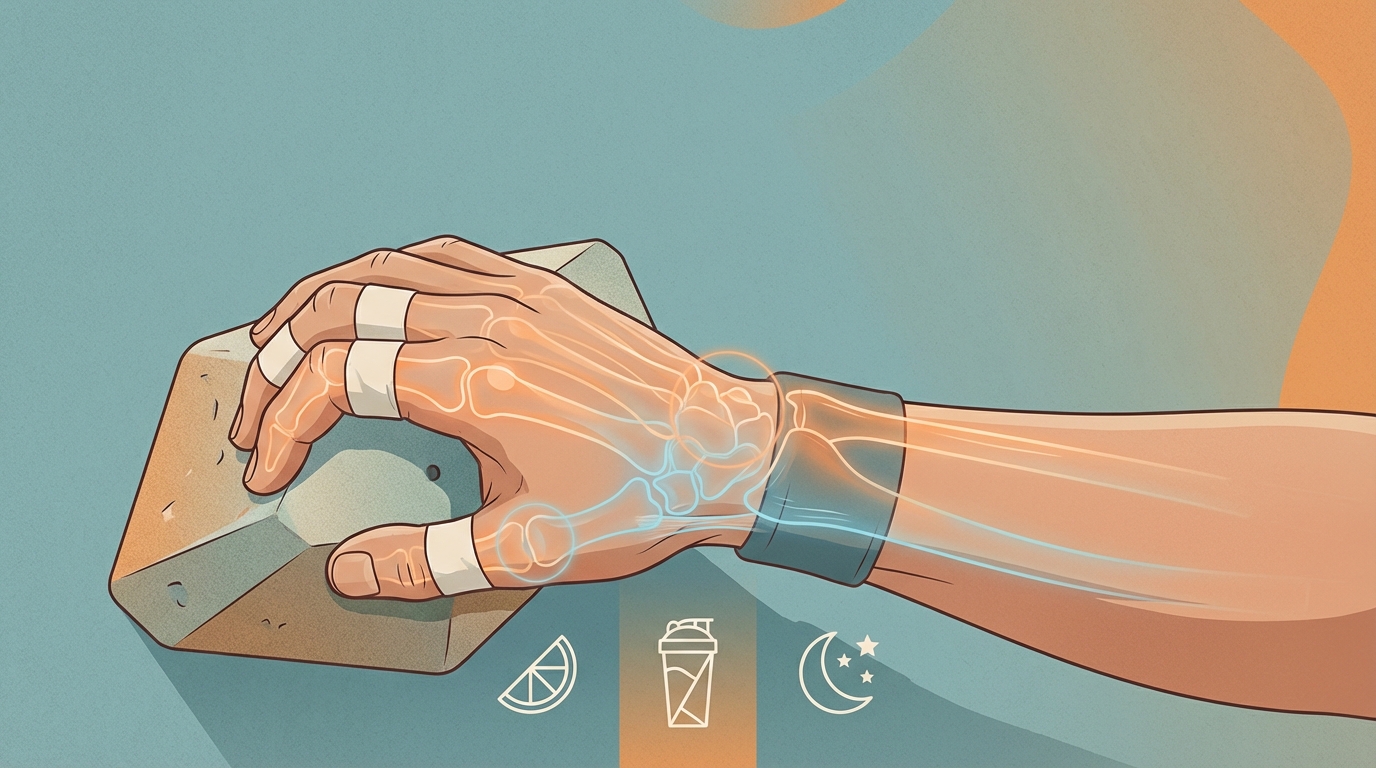
💪 Adequate protein to repair connective tissue
Tendons are made primarily of collagen, a protein that needs sufficient amino acids for repair. Studies indicate that adequate protein intake, distributed across the day, supports connective tissue recovery.
Sources: legumes, tofu, eggs, dairy, or combined plant proteins.
Evidence: Thomas DT et al., 2016; Shaw G et al., 2017.
🍊 Vitamin C and collagen
Vitamin C directly supports collagen synthesis, a key component of tendons and ligaments. Some studies show that consuming gelatin or collagen with vitamin C before training can increase collagen synthesis in connective tissue, though clinical evidence remains limited.
Vitamin C sources: citrus fruits, kiwi, bell peppers.
🧲 Minerals that strengthen tissues
Zinc and copper act as cofactors in collagen formation and connective tissue stability. Keeping levels adequate helps tendons and ligaments adapt better to training.
Sources: nuts, seeds, legumes.
🛌 Rest and progressive loading
Finger tendons and pulleys have a lower blood supply and adapt more slowly than muscles. Because of that:
- Avoid increasing training intensity abruptly.
- Respect recovery days and periods of active rest.
5 Sufficient energy
When the body does not receive enough energy, it prioritizes vital functions and reduces tissue repair. Eating enough daily energy ensures tendons and pulleys can regenerate after activity.
References
- Shaw G, Lee‑Barthel A, Ross ML, Wang B, Baar K. Vitamin C–enriched gelatin supplementation before intermittent activity augments collagen synthesis. Am J Clin Nutr. 2017;105(1):136‑143. doi:10.3945/ajcn.116.138594.
- Schöffl VR, Hochholzer T, Winkelmann H, Strecker W. Pulley injuries in rock climbers. Am J Sports Med. 1999;27(3):362‑365. doi:10.1177/03635465990270031401.
- Hijlkema A, Roozenboom C, Mensink M, Zwerver J. The impact of nutrition on tendon health and tendinopathy: a systematic review. J Int Soc Sports Nutr. 2022;19(1):474‑504. doi:10.1080/15502783.2022.2104130.
Keywords

Abril Guita
Nutritionist
Functional and integrative nutritionist | Collaborator on the app’s nutrition area.
Follow on Instagram (@nutricion.ag_)